
TrailLink - Communication Device
A lightweight, battery-efficient peer-to-peer (P2P) communication system designed to keep hiking groups connected—even in remote areas with no Wi-Fi or cellular service. Check out our final video! (Shout out to Alex Apollonov!)
Overview
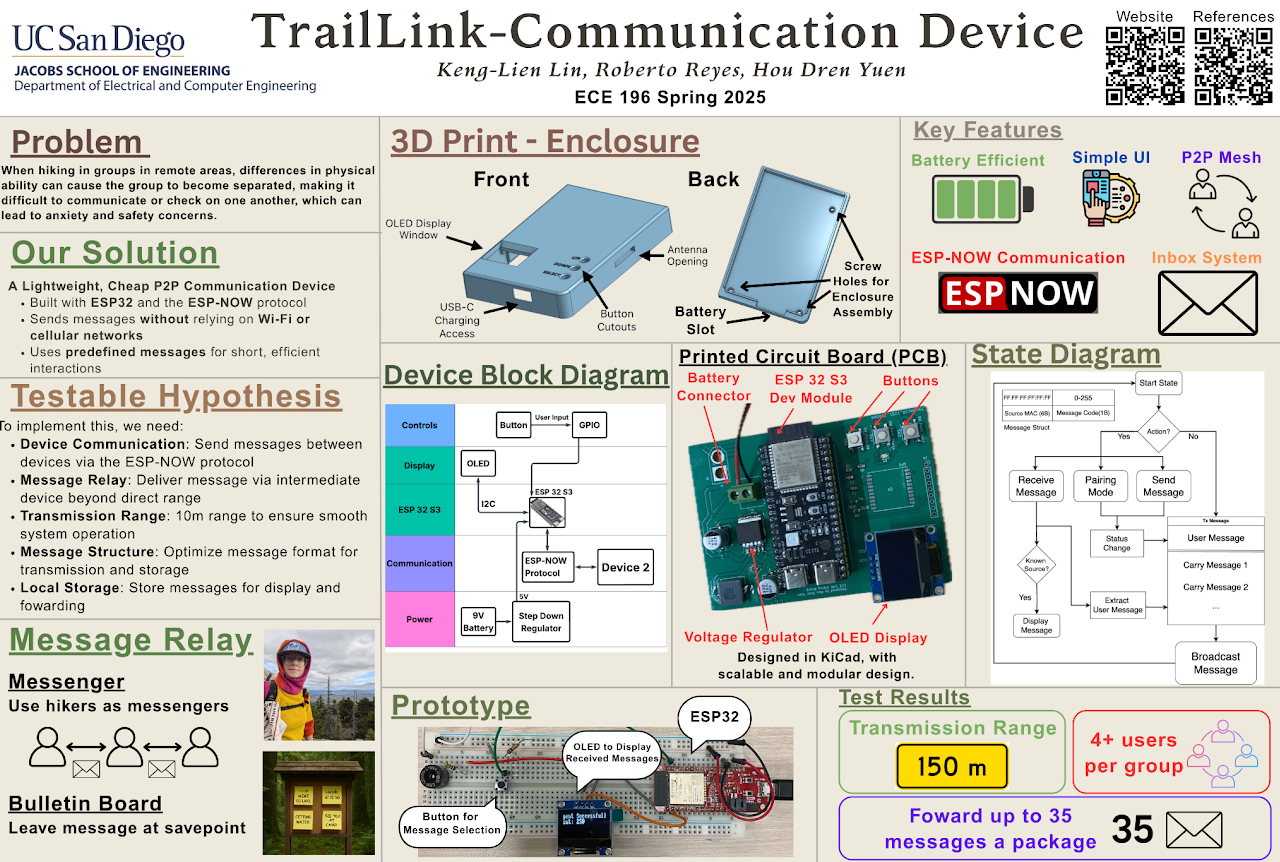
TrailLink is a simple and reliable messaging device that uses the ESP-NOW protocol to enable short, predefined message exchanges between hikers. Whether you’re hiking, camping, or in areas with limited connectivity, TrailLink ensures your group stays in touch.
🛠 Built with ESP32 S3
📶 Communicates using ESP-NOW (no internet required)
📬 Supports predefined messages for efficient interaction
🔋 Battery-efficient and portable
📦 3D-printed enclosure for durability in the field
Problem
When hiking in groups across remote terrains, physical distance can lead to disconnection and safety concerns. Cellular and Wi-Fi networks often fail in such environments, making a dedicated offline communication system essential.
Key Features
-
Battery Efficient: Runs on a 9V battery with power regulation
-
P2P Mesh Networking: Uses ESP-NOW for direct or relayed communication
-
Simple UI: OLED screen for reading messages and button-based input
-
Inbox System: View received messages
-
Message Relay: Messages can hop across intermediate devices
-
Transmission Range: ~150m verified range
-
Scalable: Supports 4+ users per group and up to 35 messages per package
System Architecture
📦 Hardware
-
ESP32 S3 Dev Module
-
OLED Display (I2C interface)
-
Push Buttons for input
-
9V Battery + Voltage Regulator
-
Custom PCB (Designed in KiCad)
-
3D Printed Enclosure with access for USB-C charging, buttons, and battery
🧠 Software
-
ESP-NOW Protocol for low-power, low-latency communication
-
Message State Machine for managing send/receive/relay
-
Predefined Message System for quick, structured communication
-
Inbox and Bulletin Board System: Savepoint-based messaging
Device Block Diagram
Message Relay Mechanism
-
Messenger Mode: Users carry and forward messages physically across nodes.
-
Bulletin Board Mode: Devices left at fixed locations act as message savepoints.
State Diagram
The device follows a structured flow:
-
Start State
-
Action Decision (Send, Receive, or Pair)
-
Based on input:
-
Send → Carry/Broadcast Message
-
Receive → Display or Store Message
-
Results
-
✅ Tested Transmission Range: 150 meters
-
✅ Support for Groups: 4+ users
-
✅ Scalability: Up to 35 messages per transmission
-
✅ Reliable P2P Communication without needing Wi-Fi or mobile data
Authors
-
Keng-Lien Lin
-
Roberto Reyes
-
Hou Dren Yuen
Developed as part of ECE 196 (Spring 2025) at UC San Diego - Department of Electrical and Computer Engineering